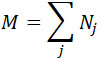
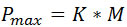
Participant count
What is a Participant Count?
A participant count consists of producing an estimate of the number of participants in a Ciclovía Recreativa program, by means of several predictions.
What is the purpose?
This information is an indicator of the impact the program has on a city or municipality. It is useful for making comparisons between different times of the year or between yours and other programs. These data are also useful for conducting a cost-benefit analysis.
Requirements
This study is based on the following assumptions:
- People are randomly dispersed on the street; the density (number of people in a given area) is the same along each corridor (the distance between observation points).
- During the 15 minutes of counting there is no significant change in the predictions due to the entry or exit of people.
- The corridors are sufficiently large enough to ensure that a person will not be counted more than once during the observation period.
- A typical velocity is assigned to each group of users: cyclists 10 km/h, skaters 5 km/h and pedestrians 2.5 km/h.
- The error due to individuals turning around and being counted twice is not significant.
Tools and materials to use:
- Paper and Pencil
- Stopwatch
- Counting Form
- Calculator or spreadsheet (Excel)
What steps should be followed?
Step 1:
Selection of Observation Points: You should be familiar with the length of the Ciclovía Recreativa route and be certain of the number of people you have to assist with the counting. A good approach for determining the length of the corridors (the distance between the observers), is to divide the total length of the Ciclovía Recreativa by half the number of people available to assist. Place people at this interval along the length of the route. (NOTE: Due to the velocity of the fastest mode of transportation (bicycles 10 km/h), observation points must be at least 2.5km apart to avoid double counting over a 15 minute period.)
Defining Counting Time Period: The time period in which counting happens is 15 minutes during the peak hour of the event. During this time, the uncertainty and error are not very high. This is the standard time that various groups in charge of counting these types of events have used. It is also recommended that a count be conducted for fifteen minutes on the hour (e.g. 7:00-7:15) and on the half hour (e.g. 7:30-7:45) of every hour of operation at least once every six months. The purpose of this is to determine the distribution of the number of users throughout the day.
Step 2:
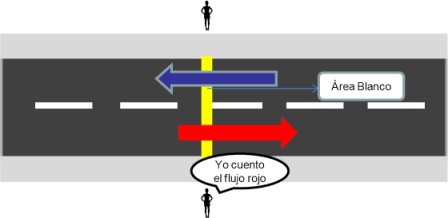
Counting Protocol Outline: Once the observation points and counting periods have been determined, two people are placed in charge of counting at each point. One person stands across from the other so each can count one direction of traffic. Chose a point and only count the people that cross that point. The count should also differentiate between the four types of activities: cycling, walking, running and skating/scooter.
Step 3:
Estimating the Number of People per Corridor: The following is a valid formula that predicts the number of people per corridor during the fifteen minute being evaluated:
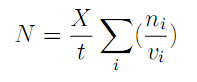
Where
X= is the length in km of the corridor,
ni = the number of total people counted by each corridor by activity
vi = is the velocity of each activity group in km/h
Warning: This formula is only valid for counts 15 minute long.
Example:
Suppose that two individuals were designated to conduct a count of people in the Ciclovía Recreativa from 11:00 to 11:15am. The results were the following: |