Evaluation tools for the Ciclovía Recreativa
|
| part 5 of 7 |
| |
Estimation of physical activity levels in the Ciclovia Recreativa
What is an estimation of physical activity levels?
In order to estimate the levels of physical activity in the Ciclovía Recreativa, an epidemiological study is carried out using a direct observation instrument.
What is its purpose?
Through this study it is possible to estimate how much the Ciclovía Recreativa contributes toward the meeting physical activity requirements established by the CDC. This consists of a useful tool for the objective evaluation of the benefit the program has in terms of promoting health and preventing disease. At the same time, the information derived from studies like this can be used in order to advocate for the program before local authorities.
What steps should be followed?
Step 1: Basic Definitions
Before starting, it is important to make clear a few basic definitions that you will use in the development of this study.
1.MET:
A metabolic equivalent (MET) is a useful measure that describes the energy spent during a given activity. It is determined by dividing the energy spent during a given activity by the energy spent during rest.
For example, an activity with a MET value of 5 means that it requires spending five times the amount of energy needed during rest.
2.MET-Minutes:
MET-minutes are obtained by multiplying the MET value of an activity by the time in minutes in which the activity was carried out.
For example, carrying out a 5 MET activity for 30 minutes results in 150 MET-minutes of physical activity (5 X 30 = 150).
3.Physical activity intensity levels:
Physical activity is classified into to light, moderate and vigorous intensity. This classification is made according to the energy spent during the activity that is according to its MET value. For adults, activities are classified in the following manner 17:
Table: Physical Activity Intensity Levels |
| LIGHT |
MODERATE |
VIGOROUS |
| < 3 METs |
3 -6 METs |
> 6 METs |
| Walking at < 5km/hr |
Walking at a moderate pace
5- 7km/hr |
Walking at 8 km/hr |
| Riding a bicycle at 12 km/hr |
Riding a bicycle at 15 km/hr |
Riding a bicycle at more than 16km/hr |
| |
|
Jogging or running |
| |
|
Skating quickly |
| Stretching |
Aerobics |
High Impact Aerobics |
| Walking with a small child |
Walking with a child in your arms |
|
| |
Going down stairs |
|
| Non-Dynamic Yoga |
Dynamic Yoga |
Karate, judo, tae kwon do |
| |
Take the dog out for a walk |
|
| |
Gymnastics |
Jump rope |
| |
Ballroom dancing |
Professional dancing |
| |
Competitive table tennis |
Singles tennis |
| |
Doubles tennis |
Competitive sports |
|
| |
| Source: Barbara e. Ainsworth. Compendium of Physical Activities: an update of activity codes and MET intensities. |
|
| |
Physical Activity Recommendations
The Department of Health and Human Services of the United States recommends that individuals engage in at least 150 minutes of moderate physical activity every week 18. Studies have shown that this frequency and level of physical activity can improve health and reduce the risk of cardiovascular disease, diabetes type 2, some types of cancer, osteoporosis and depression. It is recommended to engage in 500-1000 MET-minutes of physical activity weekly.18 |
| |
Step 2: Definition of Activities
This step will define the activities to observe during the Ciclovía Recreativa and establish an intensity level for each one. |
|
 |
| |
Step 3: Data Collection
In order to collect data, you can use any of the following counting methods: |
| |
| Counting Instruments |
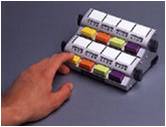
Counter Used with SOPARC
|
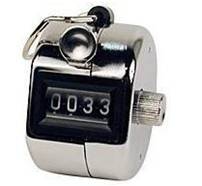
Hang Counter
|
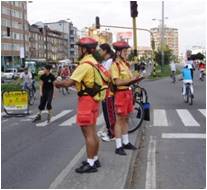
Paper and Pencil
|
| Description |
SOPARC - System for observing play and recreation in communities. This is a tool used for making direct observations in a recreational environment where physical activity is happening. |
This is a tool commonly used for head counts. The counter is held in one hand, with the index finger and thumb. |
This is the tool traditionally used for carrying out participant head counts in the Ciclovía Recreativa. |
| Advantages |
Allows for the observation and counting of four activities simultaneously. There is a defined protocol which is reproducible. |
The hand counter is of intermediate cost. There is a defined protocol, which is reproducible. It does not require special training for proper use. |
Allows for the observation and counting of four categories simultaneously. It is low-cost. Does not require special training for proper use. |
| Disadvantages |
High-Cost (USD 126) Requires training for proper use. |
Its useful lifetime is short. Only allows the observation and counting of one category per counter. One observer can operate two counters simultaneously, only allowing for the observation and counting of two activities simultaneously. |
When looking at the paper, one loses visibility of the target area. |
| Human Resources for Data Collection |
One person for the counting of four activities. One person can count both directions of traffic (South-North, North-South). |
Requires two people for the counting of four activities. A person can only count one direction of traffic. Four people are needed to count both directions of traffic. |
Requires one person for the counting of four activities. A person can only count one direction of traffic at a time. Two people are needed for the counting of both directions of traffic. |
|
| |
| Initially, the gathering of data will be carried out in order to verify the reliability of the instruments. Later, data will be gathered for the analysis. |
| |
 |
|
In case there are previous surveys, it is useful to make use of the information on the type of activities carried out in the Ciclovía Recreativa (walking, cycling or skating) and the average time in which each activity is carried out. These data will contribute to the later analysis.
Data Collection Process
1.Personnel chosen to carry out the count should receive training. The number of people and their tasks will be determined by the counting method that will be used. In the case of Bogotá, eight people were used for each counting point, two in charge of the SOPARC counters, four in charge of the hand counters, and two in charge of counting by paper and pencil. Two collections of data were obtained by each counting method and for each activity category.
2.Random selection of two measurement points, previously stratified by the number of recorded participants. The data will be taken at the points with the highest number of participants at the peak hour of circulation. In established points, the reliability of the instruments will be evaluated and their validation carried out. The instrument's reliability refers to the instrument's capability of providing similar measurements under identical conditions, meaning they are reproducible. On the other hand, the validation of the instrument refers to how comparable the measurement taken by an instrument is to the measurement of an instrument considered to be the 'gold standard'.
3. The two points will be evaluated on two different Sundays, carrying out simultaneous measurements of 15 minutes twice an hour throughout the duration of the Ciclovía (from 7a.m. to 2 p.m.). The counting consists of recording on the SOPARC counter every time an individual passes by a point 'X' engaging in one of the activities defined in Table 11. In addition to the measurements carried out with the SOPARC counter, the hand counter and paper and pencil counts are conducted at the same time.
4. Entering the Information in a Database: In a spreadsheet, you should construct a table that contains the collected information, organized in a matrix like the following:
|
| |
| Method: |
SOPARC |
| Count # |
1 |
| Location: |
Parque Nacional (National Park) |
| |
Cycling |
Running |
Walking |
Others |
| Start Time |
Evaluator 1 |
573 |
16 |
77 |
12 |
| 10:30 |
| Stop Time |
Evaluator 2 |
573 |
18 |
82 |
11 |
| 10:45 |
OBSERVATIONS:
|
|
|
How is the form filled out?
- First enter the location of the count, the description of the place of observation, the start time of the count, the evaluator and counting method being used.
- Next enter the number of individuals counted in each category (activity) by each observer. Finally, enter the stop time of the count and any observations.
- It is important to take into account the order of the counts, meaning, having the sequence of the counts present and the time of each one. It helps to number them, in order to align the entered data with the film of the count, if that is being conducted.
- Tabulate the date in a simple Excel spreadsheet. They are classified by physical activity category and counting method. The goal is to obtain the total values of the counts organized in a matrix that allows them to be transferred to whatever program you are using for analysis. For example:
|
| Bicycle SOPARC1 |
Bicycle Hand Counter1 |
Bicycle Paper1 |
| 403 |
403 |
399 |
| 522 |
523 |
508 |
| 195 |
199 |
566 |
| 573 |
566 |
564 |
| 491 |
492 |
492 |
The title of each column codifies:
- First: the category that is being observed.
- Second: the counting method used.
- Third: the count number.
|
|
Step 4: Data Analysis
The statistical analysis for the evaluation of the reliability is the non-parametric Spearman Correlation Coefficient or the intraclass correlation (ICC). This test allows for the evaluation of the general agreement between two or more methods of measurement or different observations (for more information: http://estadistico.com/dic.html?p=4583).
What calculations should be made?
Once the data has been collected, it will be possible to calculate how much the Ciclovía Recreativa contributes in terms of MET-minutes towards fulfilling physical activity recommendations. Assign a MET value to each observed activity (see Table 11 – Definition of Activities), based on the average length of participation in the Ciclovía, obtained from previous surveys. An example of these surveys from the Ciclovía of Bogotá can be found in the following table.
Table: Duration of Participation in the Ciclovía Recreativa of Bogotá. |
| Duration of Participation |
Total |
Type of User |
| Walking |
Cycling |
Use of other wheels |
| Less than an hour |
70481 5.0% |
47720 7.1% |
21129 3.3% |
1632 2.0% |
| Between one and two hours |
373458 26.7% |
225214 33.6% |
127906 19.8% |
20338 24.4% |
| Between two and three hours |
388821 27.8% |
176301 26.3% |
183086 28.3% |
29434 35.5% |
| More than three hours |
567513 40.5% |
220993 33.0% |
314655 48.6% |
31865 38.3% |
| Total |
1400273 100% |
670228 100% |
646776 100% |
83269 100% |
|
| Source: Universidad Nacional de Colombia, Science Faculty, Department of Statistics. Recreation and Sports Programs. Evaluation 2005. December 2005. |
|
|
| |
For example, if a person spends an average of three hours at the Ciclovía Recreativa, cycling at 5.5 METs, then the Ciclovía Recreativa is contributing 990 MET-minutes (5.5 x 180= 990) in this specific case. The advantage of using a spreadsheet is that is allows calculations to be made through simple formulas. |
| |
| MET |
Active Time |
|
| 4 (walking) |
60 minutes |
240 |
|
| |
Table: The number of MET-minutes by physical activity type and duration in the Ciclovía of Bogotá. |
| Activity/Time |
< 1 hour |
1-2 hours |
2-3 hours |
>3 hours |
| WALKING |
≤ 240 |
240 - 480 |
480 - 720 |
≥720 |
| CYCLYING |
≤ 330 |
330 - 660 |
660 - 990 |
≥990 |
| USE OF OTHER WHEELS |
≤360 |
360 - 720 |
720 - 1080 |
≥1080 |
|
Source: Cardona AM, Medina P, Sarmiento OL, Akira A, Zarama R. Adaptation and Validation of the SOPARC Direct Observation Method for the Estimation of the Physical Activity Contribution in the Context of Bogotá's Ciclovía. |
For more information, you can contact: Olga Lucía Sarmiento: osarmien@uniandes.edu.co or Ana María Cardona, ma-cardo@uniandes.edu.co |
|


